Friday, May 11, 2012

Spring Pigs

Today marked a milestone in our adventures in country living.  Sure, chickens are great, but every hipster in Seattle has got him or herself a backyard flock.  Shoot, any good flock of chickens just about comes with a pair of skinny jeans, some ironic facial hair, and a can of PBR.  But you know you are going beyond the trendy when you step into bona-fide livestock.  So that's what we did.  Time to dust off the Curriculum Vitae and add "Pig Farmer" to the list of life skills.

We picked up our four piglets today from new friend Pablo at Mountain View Family Ranch (www.mountainviewfamilyranch.com).  The pigs are being raised on the farm property that we have been rehabilitating with friends.  They get a very large paddock, deluxe all the way.  We had to do some work to make it right, including fence repair, gate replacement, and electric-fence installation.  We knew that the pigs would be ready for pick-up in early May and the day finally arrived.  We had some last-minute adjustments to make, but moved the four little ladies in late this morning.

There has been a lot of interest in this project as it picked up steam.  The four pigs we have are going to be divvied up between six or so families - when word started getting out, we could easily have bought ten or more, there was that much interest.  But we are keeping our first venture into pig-raising modest in scale.  It is a five-month investment, these cuties are slated for the chopping block in November.  That's the way of things, folks.  But they are going to get a lot of attention and love in the meantime, possibly even a trip to the fair.  Stay tuned for more farm updates as we all get settled into late spring routines here!


Tuesday, May 8, 2012

An Old Shed, A New Coop

There have been some exciting developments recently that have resulted in a great deal of work.  Real, get-your-hands-dirty, be outside kind of work, which has prevented a lot of blogging.  Blogging about work and life is a kind of derivative, a downstream product of life, like shadows on the cave wall.  I would much rather be occupied with the font of experience than the products of experience, so I make, once again, no apologies about the trickling pace of posts.  There is a great deal going on, however, and I suspect that 2012 will produce a great collection of photos and reflections!

Things like this - a new farm!  Well....an old farm....and not our farm.  Some friends have recently acquired a small, run-down farm property located just minutes away from our house here in Yakima.  They have graciously included us in a rehabilitation effort, as our two families, both interested in homestead-y kind of living, work to put animals of various sorts back onto the property.  Our plans are ambitious and far-ranging, including chickens, cows, sheep, goats, pigs and who knows what else.  We have been working hard to get the place ready for the first couple of move-ins and I have learned the first of what will surely be a whole host of important lessons.

Lesson #1:  There is no such thing as an "animal-ready" farm.

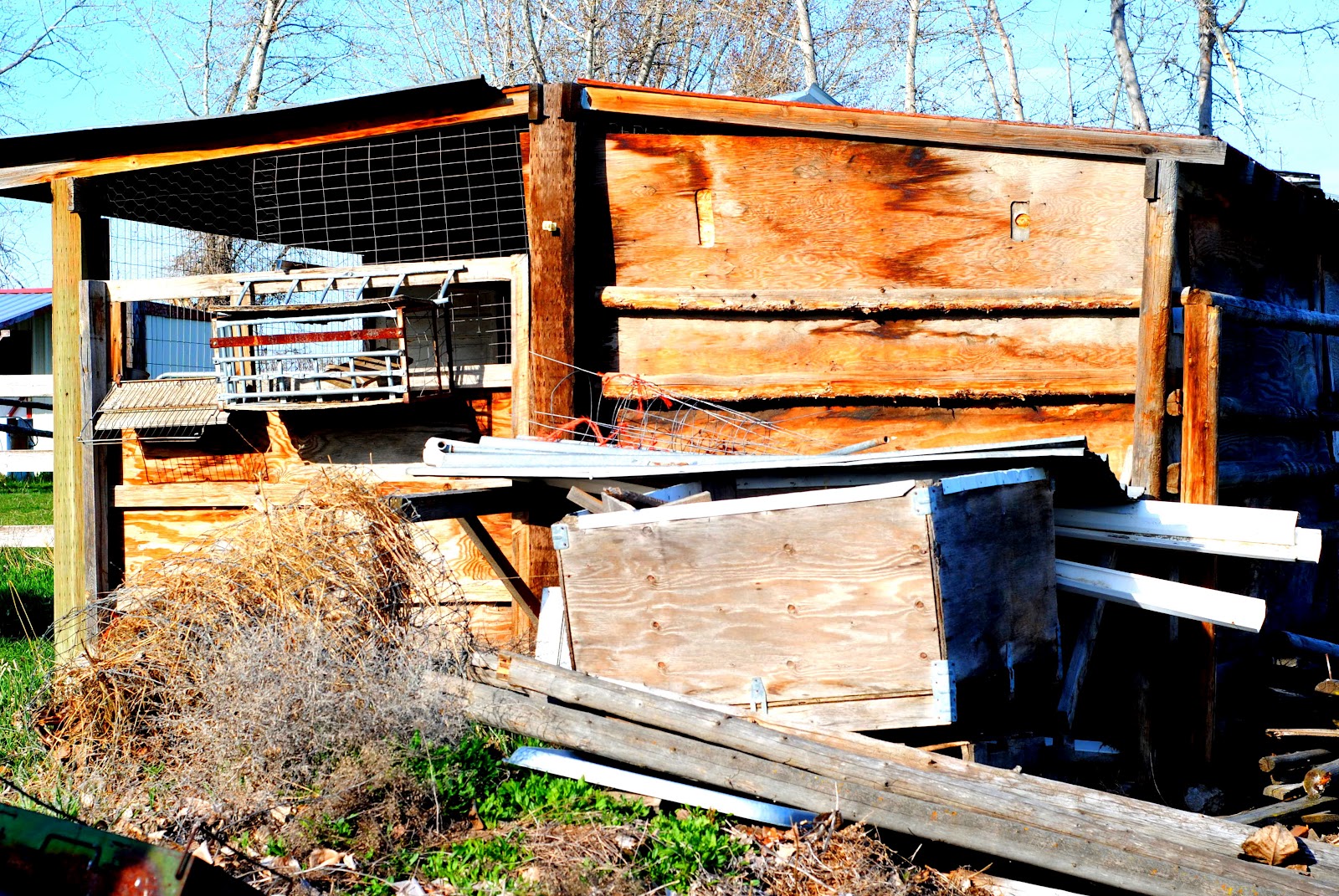
Even a property that has previously housed animals will probably need a surprising amount of work to get ready for new residents.  A great example is the new chicken coop.  We quickly identified a shed that looked like a likely candidate to be repurposed into a chicken coop.  It had previously housed a couple of varieties of pigeons and then just the scatalogical remains of pigeons.  There were various design considerations to deal with, not the smallest being that the shed had been cobbled together with a variety of materials and not a square angle in the structure.  Also a consideration was our desire to make great use of recycled materials, of which there was a large supply of around the property.  The very first step, logically, was to purchase 5 chicks from the local feed store.  These we began raising in our garage, which was a great delight to our kids.  It also started a stopwatch on the coop project.....we had about 5 weeks to get the thing ready.  Nothing motivates like a deadline.

The shed was torn apart and cleaned out.  No less than three front-loader buckets full of guano were carted away as we made the space as disease-free as we could manage.  The coop is a large design, more than capable of housing the now 14 chickens that make it their home.  A front run is open-air, surrounded by fencing and accessed by a recycled door.  The chickens access the coop proper by way of a ramp that leads to a small door.  Inside, there are roost areas and nesting boxes for all those eggs.  Four of the chickens are laying adults, and so there are already eggs being produced and enjoyed!  The nesting boxes are accessed through individual sliding doors, which the kids check daily.  New tin was put on the roof and on the sides, to make the thing look a little less like a shanty (though putting tin on that structure was a challenge, to say the least).

The chicks are all moved in an enjoying the new home, which has light and heat provided so that it will be able to sustain them through all seasons here in Yakima.  The kids check in on them just about every day, keeping close tabs on their personal favorites.

We've also been working overtime on getting one of the large paddocks on the property ready for new residents that will arrive this Friday - four pigs!  Pictures of that project and the little porkers will soon follow.  I've established my new apiary on the site as well, and will probably have about 3-4 hives working by the time summer is in full swing.  Green acres is the life for me!  Stay tuned for more updates from "the farm". 

Thursday, February 16, 2012

Putting the Kids to Bed


It has been some many months since I last posted, and I have no apologies to give, it has just been a busy time.  There have been several projects that have progressed since October, some new ones, some that have been completed.  This post is about one of those latter categories.

As the kids have grown bigger, we have been experimenting with different sleeping configurations to get the whole family to sleep.  The girls expressed interest in bunk beds, so we got this bunk frame and got it all outfitted and then found that nobody wanted to sleep on the top bunk.  Workarounds were tried, but it became clear that a new arrangement was needed.  So, off to the workshop....

The goal was to produce two identical twin beds that would come in at reasonable cost.  The girls also needed input so they would have some ownership.  Here's what came out:

I built the beds out of pine and worked off of a model I created on Google's SketchUp program, which gave me a chance to think through the design.  I laminated the legs to include through mortises which would receive the sideboards.  The headboards were the most complex, though pretty straightforward as well.

The girls picked out their colors of choice.  "Sparkling Lime" and "Strawberry Shortcake".  After the beds were finished, we created some letters out of 1/4" mdf (Evie did some of the scroll-saw work).  Shannon decorated them in color schemes consistent with each bed, and we affixed the letters to the headboards for a finishing touch.  Voila!  The girls love them, which is really all that matters in the end.  A pretty reasonable project with a fine result.


Friday, October 28, 2011

Enological Adventures in the Garage

It is hard to pick a favorite of all the great aspects of living and working in the Northwest....but this particular possibility is fighting for a top spot!  This fall we started a new adventure, one that I've been pondering for a couple of seasons now - home winemaking!  Although the Yakima Valley has long been known as the Orchard of America (I don't think that's an official title, but it should be), and the Hopyard of the US (again, making this up....but we do produce most of the hops grown in the US) the region has also been producing some great wines over the last 30 years or so.  Vineyards cover much of the hillsides of the lower valley and I have been contemplating jumping into winemaking for some time.  In preparation of the adventure, I enrolled in an evening class at the local community college last year, The Essentials of Winemaking, and got familiar with the particulars of producing wine, focusing on reds in particular.  It was also a great opportunity to get to know some of the folks in the industry - this investment of time would pay dividends later!

This was to be the year for our first foray into winemaking and I contacted a local vineyard and winery to see about buying some grapes at picking time.  The cold spring we had this year delayed the ripening of every fruit produced in the region.  The grapes I was hoping for, local Cabernet Sauvignon, would normally have come off the vine in late September, but they needed more time to develop their sugars.  Harvest kept getting pushed back one week, then another, then another.....finally the e-mail notice arrived, on the 25th of October - it was go time!

Piper and I headed out to the spot in a borrowed truck with two 20 gallon food-grade containers that I had picked up earlier this fall, outfitted with drain spigots, marked for volume gradations and sanitized.  The grapes were in large bins, picked early in the morning and then collected at the winery.  I loaded 200lbs into a separate container and then those were loaded into the crusher/destemmer (this was a very nice added bonus, to have the grapes crushed).  The crushed grapes were pumped into our containers right in the back of the truck.  We strapped them down and went to pay for them - the vineyard owner and I had been chatting through the process and he waved me off as I reached for my wallet.  "They're on me, enjoy!"  Pretty amazing....we expressed our gratitude and I promised to bring some homebrewed beer in the future (one topic of our conversations) for his warehouse crew.

Winemaking is more complex than brewing beer, but it is also more forgiving in many respects.  Wine can be adjusted at multiple stages, right up until in goes into the bottle - the chemistry is a bit more complicated than I generally have to deal with when making beer, and one is presented from the start with a dizzying array of options for additives that can enhance the process and outcome for small-batch wine.  I leaned heavily on the fantastic information available from www.morewinemaking.com as well as everything I had picked up in my class last year.  It has all helped lend some confidence as we've launched into the experience in earnest.

The must was treated with SO2 to wipe the microbiological slate clean, then yeast was pitched about 24 hours after we got it home.  Also added was an enzyme to assist in the maceration process, the extraction of color and tannins from the skins.  Other additives included a fermentation tannin, an inactive yeast product meant to increase body and mouthfeel, and yeast nutrients to aid in fermentation.  Test were run on the pH, total acidity, and sugar levels of the must - the numbers came back solidly in the ballpark for proper fermentation....I'm learning a bunch of chemistry that I probably should have learned in high school if I'd paid more attention.

The wine is fermenting nicely already and the "cap" has already formed - this is the layer of skins and pulp that is pushed to the top of the fermenting vessel because of CO2 produced during fermentation.  That cap has to be punched down twice a day and the must stirred up vigorously to help in the extraction of color and body.  I also take measurements on the fermentation with a hydrometer each time I punch the cap in order to track the progress towards the finish.  Once it has fermented "dry" (meaning all the residual sugars have been converted), we will move to the press phase.  Very exciting!

Stay tuned for updates!


Tuesday, October 11, 2011

Seven Churches


I've recently begun a new preaching series at the church, a study of the Book of Revelation.  It's a difficult portion of scripture to teach through, for a lot of reasons, but it is also a book that invites reflection through the use of art.  John's letter to seven churches in Asia Minor is full of wild imagery and so it seemed appropriate to use a variety of mediums, apart from spoken word alone, to engage the material and the congregation.  I meet with a group of creative-subversives weekly to reflect and plan on the content and direction of the worship services at WestPres and this group conceived of the first project for the series, an installation I've taken to calling "Seven Churches."

I built seven large boxes, about 3'x4', which one of our team wrapped in black fabric, creating a shadow-box sort of effect.  These were hung on seven panels on the west side of the sanctuary, and will serve as our kind of gallery space for different reflection pieces during the course of the year.  Into these boxes we put seven churches.  These were created by taking line drawings of various churches (a lot of internet searching), reproducing those drawings on black-core photo matte material, cut to size.  People have said, "Wow!  Did you draw those?!?"  Um...well, yes....but.  After projecting the images onto the matte, tracing it out roughly, then using a sharpie to reproduce the drawing to the best of my limited ability.  They are not free-hand inspirations.

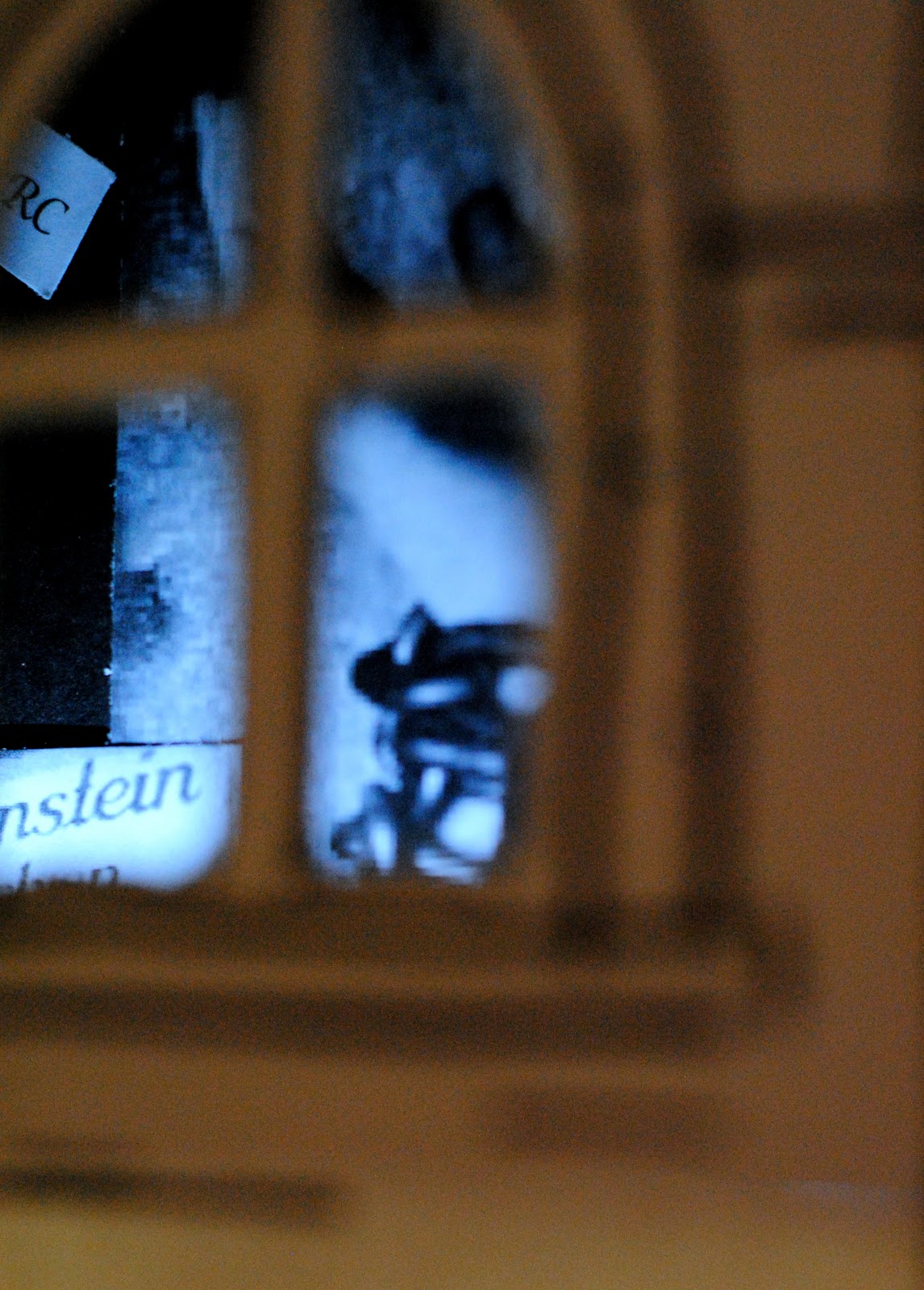
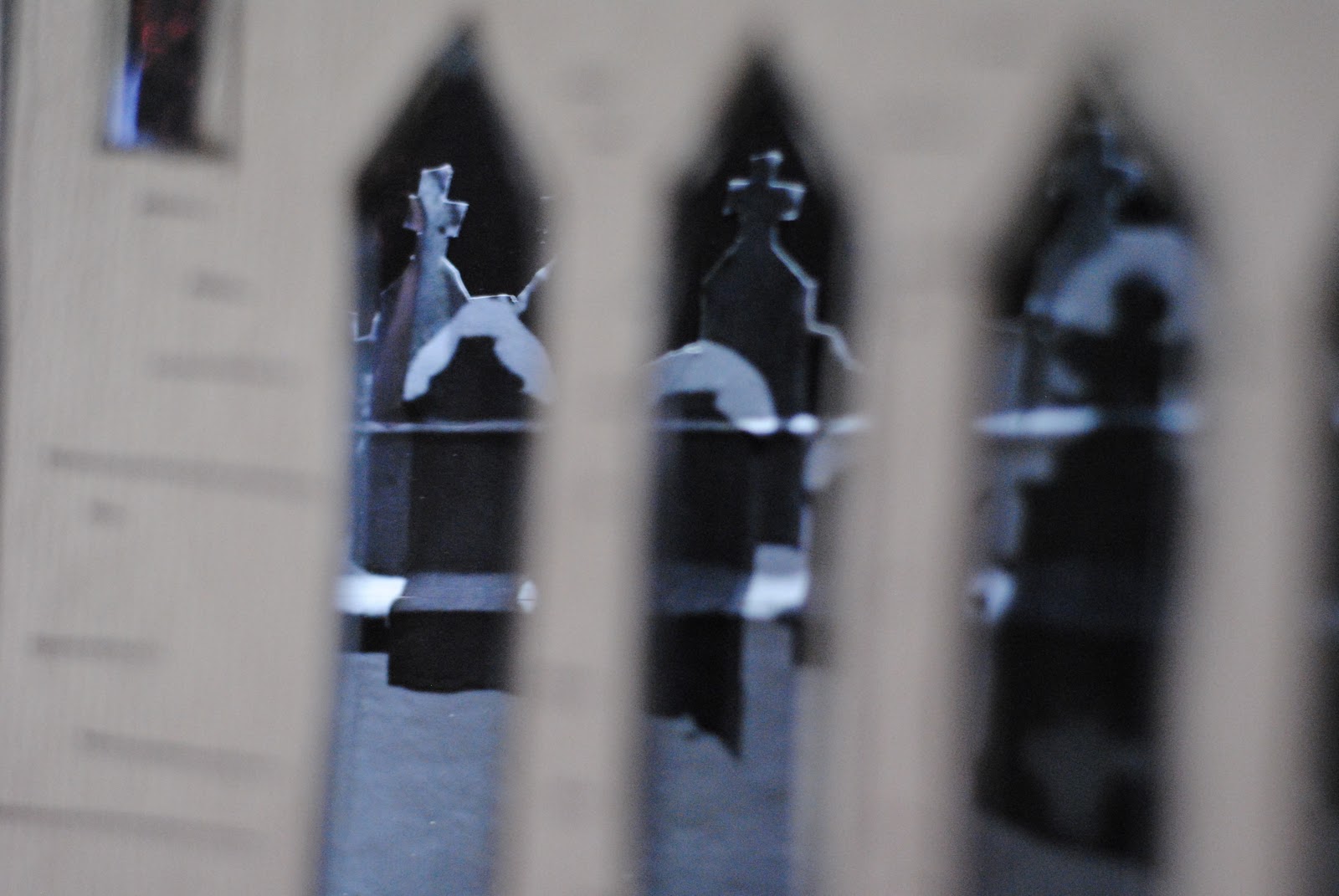
Those drawings were placed over smaller boxes, which I built to fit inside our large shadow boxes.  Each church was assigned a word, something that summed up something of the character of each of the seven churches that John wrote to in his letter.  Words like "faithful" and "corrupt", "persecuted" and "dead".  Each box was handed out to a contributing member of the team, they were tasked with creating an "interior" reality of their assigned church that reflected the word they were given.  We figured out a variety of ways to add lighting to the inside spaces, and cut out the windows in all of the drawings so that, if someone approaches the drawing, one can see inside the church, past the exterior.

The effect is pretty good - the churches are all "pretty", to choose one word, especially from afar.  They are nice to look at.  One has to get close to see that there is something going on "inside" the church, and one has to get really close to see exactly what that is.  The idea is that all churches....all individuals, for that matter....have an interior life beyond the facade that we project.  We are hard to know.  But we are known, by One who sees into all our intentions and thoughts, and John's challenge to the churches is to have the interior life and the exterior life both reflect the Way of the risen Christ.

These will remain up for the next two months or so, then we will use the "gallery" space for new works.  It is fun to work in this way - and especially fun to solicit the contributions and reflections of others.


Sunday, October 2, 2011

Sportsman's Paradise

Autumn is my favorite season for many reason - pumpkin spice lattes, cool mornings, changing colors, and for the past several years I have happily welcomed the arrival of the upland bird season.  I haven't always been an avid bird hunter, but the last several seasons I have pursued it with relish.  I had grown up hunting...well, to correct that a bit....I grew up walking along on hunts in Idaho as a kid.  We would tromp wearily through the fields, following after men and dogs, often asked to carry dead birds as part of our contribution to the effort.  I spent the school year, as I grew older, in Seattle with the city-side of the family, so bird season faded into memory.
John Napper and Stella - my quail-hunting instructors
in the Arizona high country.

Several years ago I was serving a church in the high desert mountains of Arizona and was re-introduced to bird hunting.  A friend in the church was pretty crazy for quail hunting in the badlands of Arizona, and he gave me a gun on loan for two seasons as I learned to chase Gambel's quail around the sage, cactus, and mesquite of the Prescott area.  For a variety of reasons, I found bird hunting to be the near-perfect way to soak in the local terrain and find rewarding respite from the various stresses of the job I had there.  I became one of the crazies chasing quail through the desert; in fact, I got pretty good at it.

Moving to the Yakima area was a dream come true for an upland bird hunter.  We have quail, chukar, and pheasant all available nearby and the weather in the fall is as close to perfect as one could ask for.  As the season drew closer this year, I decided to share the joy and arranged for a group of local pastors that I know to go clay shooting.  Most of the guys were very new to shooting, so I had to wrangle up a menagerie of borrowed weaponry, shotguns of all shapes and sizes.  I loaded up on ammo, taking advantage of a sale at a local sporting goods store - my cart looked like I was stocking up for a Zombie Apocalypse.  We took some time getting oriented, then ran the guys through several rounds of targets, enough to send them home with bruised shoulders and smelling of gunpowder.  A perfect day!

Dove season opens in September, but it is really just a warmup for the real deal: Opening Day!  This year, the state opened for quail and chukar on Saturday, October 1.  This is my third season here in Yakima and Opening Day has developed into something of a tradition, with a group of 4-5 hunters gathering to hunt quail at the  orchards of one of my congregants.  It is a social hunt, not too serious, but we always see plenty of birds and get a chance to shake the rust off.


This year we saw a ton of birds, and even brought a few to hand.  The dog (Simon) gave some good points, the quail were holding pretty well, an early-season trait that will wear off quite soon as they get more savvy to the hunting routine.  I hung back on some occasions, so I could get some pictures of the crew in action, but I did manage to bring home a half-dozen, and even managed a double on my first day out.  Not too shabby!  The Yakama Nation will open in two weeks, and with that comes access to some of my favorite spots as well as that king of upland hunting: the ringneck pheasant.  But, more than almost anything else, it is the long walks in the beautiful northwest setting that I like the most.  Another hunting season is here - and I couldn't be happier!