Saturday, October 20, 2012

Primal Cuts

This past Friday I traveled to the far reaches of Whidbey Island, located in the Puget Sound, to take part in an instructional class of a unique kind.  A small number of participants gathered for several days of shared work, taking two pigs from the host farm through the entire process of harvest.  Our own pigs are fast nearing their harvest date, so this was a timely opportunity to gain critical experience.

WARNING: WHAT FOLLOWS IS A POST THAT DESCRIBES THE DIVIDING OF A PIG CARCASS INTO USEFUL PORTIONS OF MEAT MEANT FOR CONSUMPTION.  THERE WILL BE PICTURES.  IF THIS TOPIC OR THESE PICTURES PROMISE TO BE OFFENSIVE TO YOU, PLEASE DO NOT READ THEM.  INSTEAD, ENJOY THIS PICTURE OF THE MUKILTEO-CLINTON FERRY IN THE RAIN.  TO CONTINUE READING THE POST, SIMPLY SCROLL ON DOWN.

The class was hosted by the crew at Farmstead Meatsmith.  I have been lurking on their website for the better part of this past year, trying to glean from the excellent and beautiful instructional videos some of the techniques we would need to put to use as we eventually come to the task with our own animals.  Apart from the very practical discussion, you also end up getting a look at some recipes and food treatments that make it clear that those folks are foodies as well as butchers and abattoirs.  And they weave in some of their philosophical commitments that undergird their choice to get this personal with their food experience.  It is no small vision; more than an economic argument and bigger than a nostalgic look back to days past, there is a commitment to community life, to hospitality, to stewardship and to generosity.  The commitment to these values goes beyond a claim on them as the niceties of society - they are seen as vital, necessary, needful....I would say even strategic.  By that, I mean that members of a community practice these values as a way to pursue their ability to survive and thrive - and so the whole interdependent community around them does as well.

That may all sound a bit high-minded for a class on butchering a pig.  But our connections to one another, our connections to food and to the animals that we take it from, to the land that we take it from - these connections have all been weakened in our contemporary culture of commoditization.  The plastic wrapped packages of meat we buy in the store, or the neatly arranged piles of fruits or vegetables soaking under the misters in the produce aisle, these are far removed from their places and processes of origin.  Regaining a connection to our food is a way to not only regain control over the quality and economics of our food, but also a way to explore the reforging of those connective paths between our food and each other.

And now, here is a picture of a philosophical butcher in training - my brother Alex.

Alex is a shareholder in our little herd of pigs and so is also preparing for the big day.  He participated in all three days of the class, which covered topics like slaughter and evisceration, butchery and meat curing.  He also managed to harvest a deer while on the Island, a timely accomplishment considering the number of cutting boards, knives and other processing tools located at the farm site.

Our instructor was Brandon Sheard, who led us through the steps to take full sides of pork and transform them into usable cuts of meat.  The pigs had been processed the day before, so when I arrived on Friday they were already cleaned, divided, and chilled - what was left were four sides of pork.  Alex and I had one side to work with between us, and we first divided it into quarters (two shoulders, loin and side).

All of the traditional pork cuts that you might find in the grocery store can be found in these quarters, and there are some non-traditional cuts hiding in there as well.  What becomes abundantly evident early on is just how much food one pig can produce for a family or community.  Brandon made a comparison to "loaves and fishes"....with each cut, the food seems to multiply.  This abundance is part of what invites and encourages hospitality surrounding the harvest.

That hospitality was well-modeled by our host site - a picturesque farm property hidden in the deep forests of Whidbey Island, the host family provided a beautiful locale for the class.  It is hard to express just how warm the reception was - not only did we accomplish the butchering in the comfort of a large kitchen setting, we were treated to food and drink at every turn.  Homemade cheese, pickled beets and beans, spicy garden salsa, even some very local spirit distilled from apples and aged in oak.

Our quarters turned slowly, cut by cut, into pork chops, tenderloin, boston butt, picnic roasts, leaf fat, back fat and, of course, bacon.  Or at least, belly, which would eventually turn into bacon.  Or cured into pancetta.  Or roasted into delicious.  That's the thing, there are so many possibilities, one side is 150 lbs of potential - a foodie's mother lode.

The instruction was very useful, the best kind of hands-on work that I needed to feel more confident as we approach our big harvest day.  The experience gained will help insure that our own pigs' life ends in as humane and respectful way as they have lived, and that we are able to maximize the ways in which our family...and our community....will be able to benefit by that gift.




Wednesday, September 12, 2012

Surplus and Stitches

For the past several years I have really enjoyed the upland bird season here in the Yakima Valley.  Chasing quail, chukar, and pheasant through the big landscapes of the mountain west is one of my favorite pastimes.  One of things this kind of hunting has in its favor is the relatively low-maintenance nature of it - there is very little stuff one needs to do it.  A gun, some clothes appropriate for hiking, and a vest that can carry shells, maps, water and the like - and the vest should also be orange enough to make you visible to others in the field.

Now, of course, you can go much, much deeper than that into the gentleman-hunter's rabbit hole.  Many thousands of dollars can be spend on nearly any of the above-listed items.  Specialized clothing suppliers wills happily sell you hunting boots for $500 a pair, and "shooting clothing" made by manufacturers like Filson will ready you for the field shoot and the photo shoot....if you have the green to pay for all that orange.  I appreciate the craftsmanship, but I am not possessed of such limitless funds....there must be another way!

After several seasons of some stop-gap designs (strapping orange to my fishing vest, for example) I had enough experience to settle on some specific needs and wants in whatever would become a more permanent replacement.  I pined over some high-dollar strap-style hunting vests like the ones by Filson, or Browning, but couldn't quite get over the price hurdle.  Tempted many times, I was unable, ultimately, to imagine any version of a conversation about the receipt with my wife that ended well.  Some of those imagined conversations, in fact, ended badly...very badly.

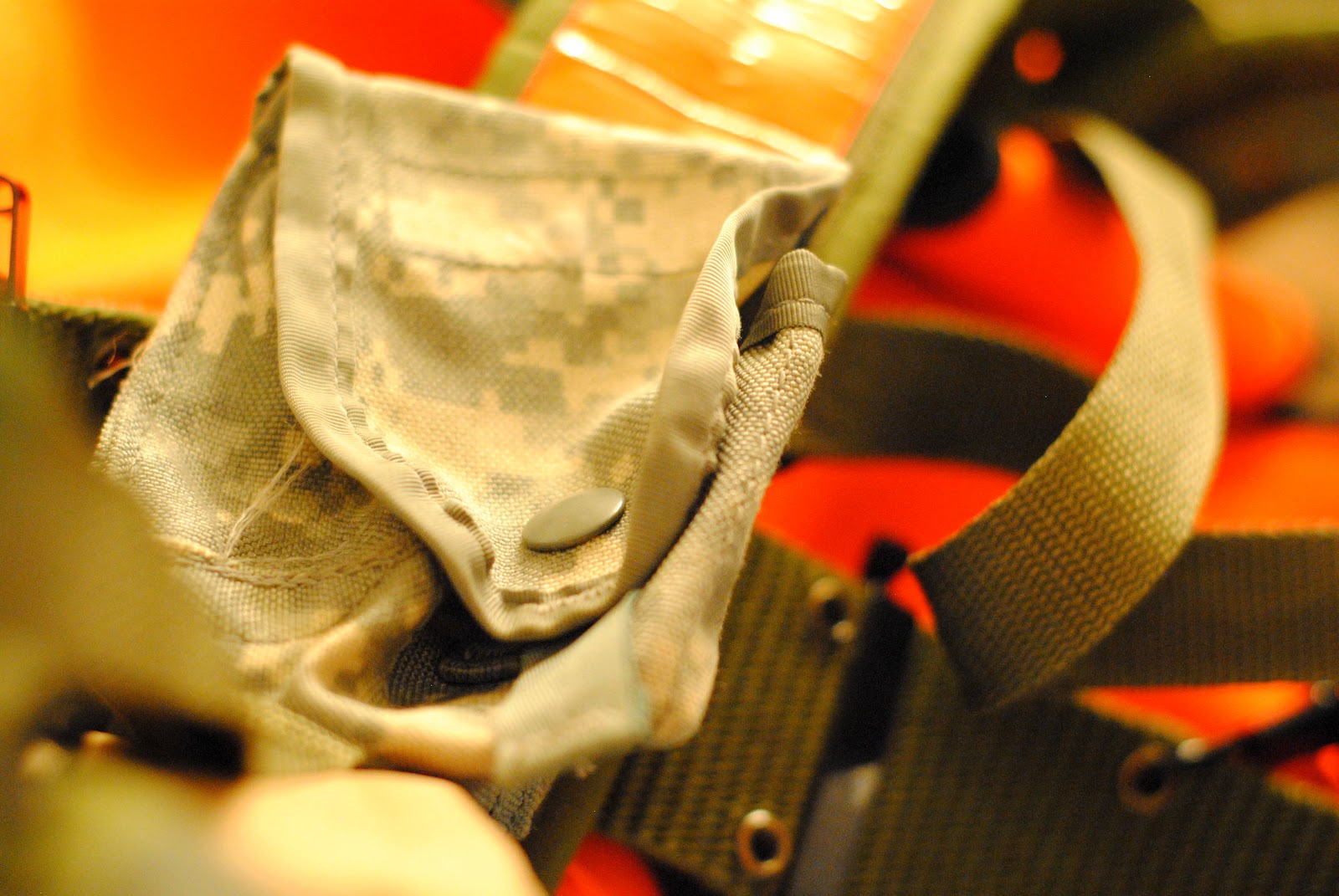
So, armed with some design ideas and a slim budget, I was off to the surplus store.  There I found all manner of old army stuff that, when creatively combined, created the foundation for a vest.  What it lacked was a game bag, a place to keep the birds, and enough orange to make it 'legal' in the field.  A quick stop at the fabric store yielded several small patches of fabric that would do the trick.  Equipped with needle and thread, I got to stitching.

The result is a vest I'm pretty excited about.  It incorporates a lot of small features that I have settled on as useful for some of the particular rigors of chasing chukar up and down the rimrock ridges of central Washington, including a water bottle (although the vest would be compatible with my camelback water system as well), and generous pockets for shells.  I have also added a cell phone pouch, and a document bag, something to hold maps, licenses and the paperwork required for hunting on the land of the Yakima Firing Center (the US Military base located near Yakima....which happens to include great chukar habitat).  The game bag has been made water resistant and, lined with rip-stop nylon, should prove durable as well.

The product, as good as it looks now, remains untested.  October 6 marks opening day for quail and chukar on state lands, so its debut is coming soon.  It may not have the panache of its big-money cousins, but I think this homegrown vest will hold its own.


Big Chickens


The chicken coop, renovated and populated this past spring, is now settled into high productivity.  We have fourteen hens in the 'big house' and they have all finally come into their own as proper layers.  They had started out as three factions: five chicks raised in our garage, five chicks raised in our friends Keith and Ruth's garage, and four layers given to us by someone who just had too many chickens running around.  Those cliques were impenetrable as the chicks grew up into teenagers, the separate groups would band together, eyeing one another suspiciously - a poultry version of Westside Story.

But these days the old animosities have been left behind.  There is reconciliation in the big house, and the hens get along very well.  We haven't had any incidents of them picking on one another, pulling feathers, or that kind of stuff, though we have heard stories of such things becoming a real problem.  With fourteen layers in there we are now getting up to 1 dozen eggs a day.  Usually it's somewhere around 8-9, but occasionally they get fired up and crank out a full dozen.  They are also spending a great deal of time free-ranging these days.  We often leave the coop door open 24 hours a day, and the girls find their way in and out and all around the farm property.  They especially like the peach orchard across the road, and I've had to fetch them out of there on occasion.

One hazard of such a free and easy lifestyle is that the hens can sometimes get a little sassy about where they are laying their eggs.  The other day I was rounding them up from their daytime haunts around the farm, and while chasing several out from under a boat tarp, came upon Red Ranger, Tavish's favorite hen, who had clearly been holding out on us.  She is a new layer, her eggs still on the smaller side, and she had been depositing her eggs each day in a private spot, and was trying, in all earnestness, to hatch those little things.  This task is beyond her, of course, since the eggs are not fertilized.  We have since dissuaded her from this course and she has mended her ways.

Putting all these eggs to use is a challenge, but egg-rich recipes like brioche and lemon curd help make a notch in our supplies.  We give some away, the girls may start selling them by the dozen, and of course the pigs look forward to a score of hard-boiled treats now and then.

Meanwhile - a new flock is being developed on the other side of the farm!  Eleven birds of mysterious parentage, dropped off at a tender age.  Keith and I repurposed one of the horse stalls into a new walk-in coop, opened a door to the outside world and stopped feeding them after several weeks.  These are our wild birds, who free range because they have to!  We make plenty of water available, provide roosting poles and nesting boxes (which they don't make use of quite yet, still being of a tender age....mmmm....tender chicken).  I catch sight of these feral chickens on occasion as they dart in and out of the weed patches around the property.  They like to patrol the pastures where the larger animals graze, so the pigs and the horse each get their company during the day.  They seem to be doing very well, and this experiment in pastured, free-range poultry looks to be a success.  When they get to laying age, we will restrict their movement some in order to get them established in their laying routines, and then they can pursue their vagabond lifestyle once again.    

Tuesday, September 11, 2012

Setting Things Up

It has taken a couple of years, frankly, for us to get up to speed on the whole canning thing.  Our first couple of attempts at fruit jams failed, which put an early damper on our experiments.  But, after taking in some more information, after a few more trials and tests, we are up and running and loving the results.

Our pantry is quickly filling up with a colorful variety of jars that contain summer produce in tasty forms.  The first wave was early fruit, and includes blueberry syrup, apricot jam (apricots from a neighbors tree), blackberry jam (from a phenomenal thornless bush growing at the farm), plum jam (a bag of mystery plums left at the church, which yielded a ridiculous product), and recently added to the collection: jalapeño jelly.

Tomatoes are our most recent obsession.  They are now ripe and plentiful, and I regularly bring home several pounds from the church garden.  We are canning these in a variety of ways, including cooking down for tomato sauce, mixing in with other garden goodness for homemade salsa, and chopping and packing just as they are (minus skins and seeds).

There is a strange happiness that arises when one looks into a pantry full of food that is set up for the winter months, food that you have put work into harvesting, food that you know.  This is a skill that many in my generation and younger are rediscovering and taking great pride in.  It can be as easy as buying fresh local fruits or vegetables when they are cheap and available and turning them into tasty products that you can enjoy all year long.  For some great recipes and advice on canning, don't forget to check out the PickYourOwn website, which is full of good information on how to do all this safely.

Pigs, Pork, and Associated Perils

WARNING:  WHAT FOLLOWS IS A POST ABOUT THE RAISING OF ANIMALS AS A SOURCE OF FOOD.  IT IS INTENDED FOR AUDIENCES INTERESTED IN SUCH PURSUITS.  IT IS NOT INTENDED TO OFFEND THOSE WHO ARE NOT.  THE BEST WAY TO AVOID THIS OFFENSE IS TO SKIP TO ANOTHER POST.  THIS BLOG IS NOT A SITE FOR DEBATE.  I LIKE DEBATE.  BUT THIS IS NOT A FORUM FOR SUCH DISCUSSIONS.  CARRY ON.

Back in May we welcomed four piglets to the farm, our spring pig project had begun.  It is a five month experiment in raising our own animals, caring for them, and eventually harvesting those animals for food.  There is a lot of rationale for such an endeavor, and many benefits, but I am not here to convince you of the merits of such a thing, only to share our experience in it.  I assume if you are reading this that you have come to terms with your omnivorous nature and won't begrudge me my own.  If you have committed yourself to other ways of feeding the wondrous machine that is your body without animal proteins, then you have my admiration and well-wishes.

Our young pigs back in June, starting to grow.
Pigs are fantastic animals.  And I'm not just talking about their unparalleled superiority in the minds of the culinary world.  It has been a lot of fun to raise our four hogs up on the farm this year.  They started out at about 20-25 lbs each, cute as a button and full of fun. They were pretty skittish upon moving into their new digs in May, but it didn't take more than a week before they had warmed up to their caretakers and their new home.  The kids enjoyed coming by to see them and I liked running the length of paddock with a stampeding porcine herd in pursuit.

Taken in July sometime, I think.....showing a little more size.
Able to feed freely, they have grown rapidly.  These days they are all over the 200lb mark, our big girl is going to finish at 300lbs, I'm convinced.  At this size they are something to reckon with and the pig pasture has been a kid-free zone for some time now.  A curious sow can throw a wheelbarrow with one toss of her head (even if that wheelbarrow is loaded with manure and stacked with rake and shovel....ask me how I know) and their propensity to test things with an exploratory bite means that you don't really want to turn your attention away from them for too long lest you find your boot or your calf in their powerful jaws.  But they remain good-natured and our experience with them has been overall very positive.
Taken in early September, getting big now.
However, harvest time continues to approach.  These four pigs are being divided between six families, providing food for more than 20 people, not including friends and family.  We are going to be handling the whole process ourselves from a to z, snout to tail, slaughter to sausage.  It is a big task, one with no small amount of gravitas in it.  And so we are already starting preparations.

In the information age, there is a great deal of help out there for people interested in taking on work like this for themselves.  And, of course, such a pursuit has a niche community out there that is passionate about such things.  There are the foodies, the hunter-sorts, the homesteaders, paleo-dieters, and a whole crop of people coming to this through the agrarian renaissance.  One such voice comes from the good folks at Farmstead Meatsmith, an amazing resource located here in the Northwest.  They have published a series of beautiful (no really, you should go watch) instructional videos on their site that not only give some of the practical steps to farm butchery but also do a good job of introducing much of the rationale that drives so many of us to seek a different way of life, or perhaps I should say a different way of food.

In mid-October I will be taking part in a hands-on experience in side-butchery with the Farmstead Meatsmith folks over on Whidbey Island.  I have been tooling up for our own harvest, collecting knives and knowledge, and in general getting very excited about the culinary benefits of this process.  I can recommend several books that have helped in the planning, including Michael Ruhlman's Charcuterie: The Craft of Salting, Smoking, and Curing;  Stéphane Reynaud's Pork and Sons ( a beautifully photographed book about pig harvest and charcuterie in provincial France); and The Whole Beast: Nose to Tail Eating, by Fergus Henderson.

Harvest is going to happen sometime around the first week of November.  In the meantime the pigs are eating cull apples and pears, zuchinni and squash, and even the occasional early pumpkin.  They like extra eggs from the chickens when they can get them and nearly took my hand off the other day when I delivered a bag full of over-ripe plums and apricots.  We've liked the experience and are already making plans for next year.  More updates to come as we get to harvest time.....wait until I tell you all about salami!


Sweeter than honey?

There are a lot of benefits to keeping bees around.  Of course there is the honey, which is always dynamite.  I harvested plenty of honey from one of my hives this year, it has real flavor (which you just won't find in the grocery store varieties) and expresses a range of color depending on when and where it is harvested from.

This year I was able to capture four swarms for myself, which I have hived in three large Top Bar Hives up on the farm.  On top of that, I had opportunity to capture several other swarms which we placed with some aspiring new beekeepers - nice to get some other folks into the work of caring for bees!  My hope is that the hives will all be strong enough to weather the winter and will start next spring strong.  I will be able to split those colonies next year and continue to expand the apiary.

The wax not only looks great, but it smells simply amazing.
One of the side products that is readily taken from the Top Bar Hives is beeswax.  The bees build fresh comb which they use for raising young and for storing honey.  The honey storage comb is sometimes emptied out as the bees make use of the food during periods of colony growth or low forage availability.  That empty storage comb is good stuff for processing into pure beeswax.  Evie and I built a solar wax melter this summer and have been putting it to use to render out some beeswax for a special project she's interested in.  Pure beeswax has a lot of uses, but she has her eyes set on lip balm.  So we'll combine this wax with some other natural products and start turning out Evie's first line of lip balm soon.  It's sure to be the hot item this winter for all those chapped lips out there, so keep your eyes open for our young entrepreneur's announcement about available product.

Let's Go Fly a Kite

A great gift came to us in mid-late August this year - a family in the church offered us a week at their time-share property in Long Beach, WA.  The summer temps in Yakima had been unbearable, a long string of triple-digit-days, and we were ready for some respite on the Washington coast.  The trip was our last hurrah before school started for the kids, so we packed up and headed towards the sea, making the 4.5 hour drive from Yakima in about 4.5 hours.  Textbook.

One of the cool things happening at the beach that week was an International Kite Festival.  The sky just outside the hotel was filled with fantastic displays every day of the week!  We settled into a routine of sorts, taking a stroll down the boardwalk nearly every day and taking in the festival.

 The loop back towards the hotel took us back through town and we quickly discovered a candy store on the route.  The kids liked stopping in there and perusing their merchandise! 

One of the cool features at the festival was a kids' kite pavilion which offered the kids a chance to make a kite of their very own.  They selected colors and fabric and soon enough they were joining the ranks of kite-flyers on the beach.

A kite festival has a great, mellow vibe to it.  The display of color and design is pretty mind-blowing (kite humor), but there is not much more to taking it all in other than relaxing near the beach and enjoying the view.  This makes for a pretty relaxing week, which is just what the doctor ordered.  The kids spent many, many hours in the hotel pool, which was kept at a balmy 80 degrees or so, and we spent time walking the beach every day.

The kids want it to be a new tradition, a yearly trip to the beach and to the kite festival.  Whether it works out that way or not, we certainly enjoyed our trip and would gladly do it again.  Enjoy the pictures!